
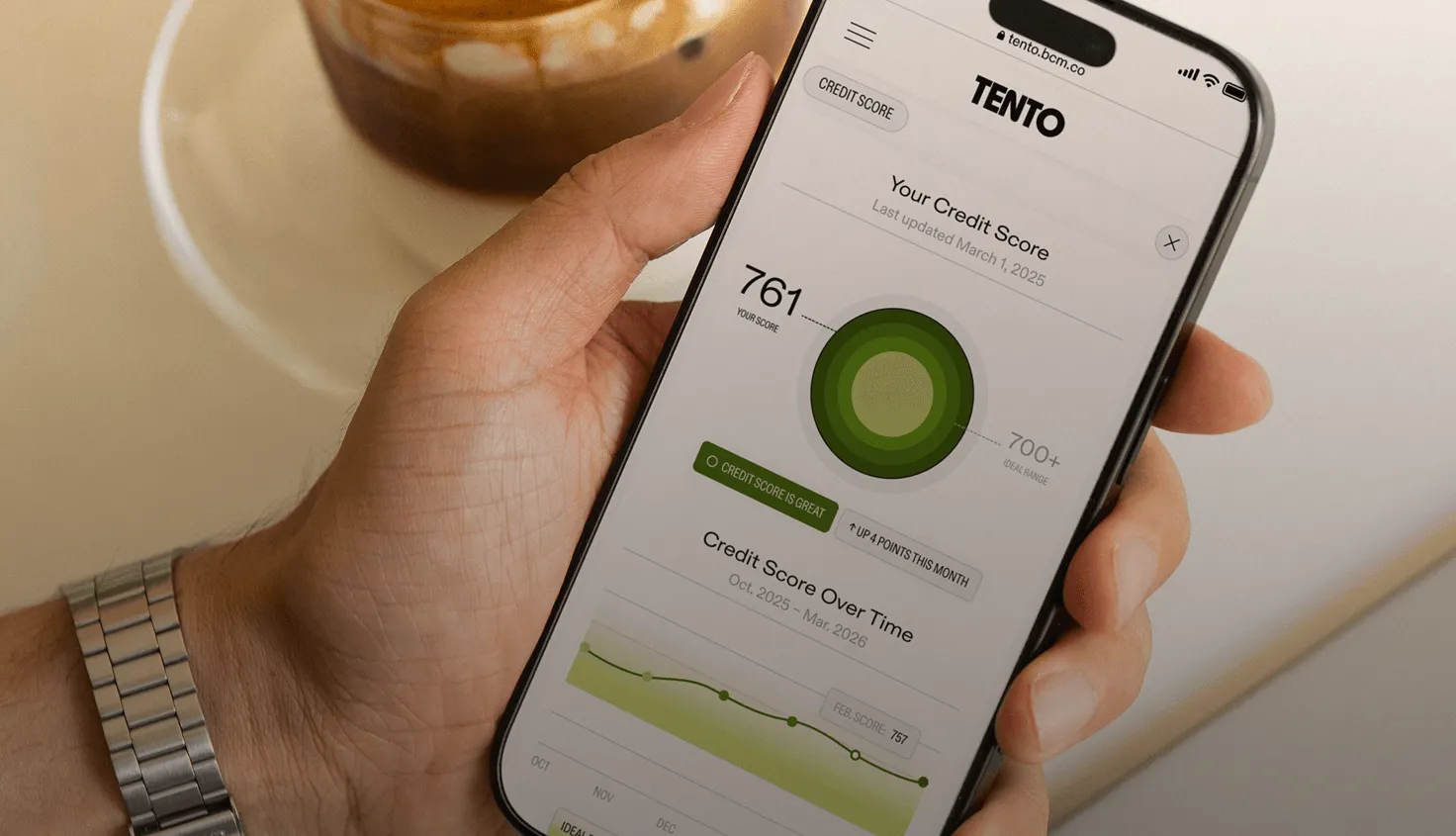
Understand your business credit score, for free.
Unlock your business credit score with ease. Know where your business stands, and what it takes to keep growing.

Most business owners have no idea this number exists.
Your business has its own credit profile — completely separate from your personal score. Lenders check it. Suppliers check it. Most owners only find out once it's already working against them.
Small business loans rejected with poor business credit as the primary factor. Knowing and growing your number is the solve.

Start for free, no hard inquiry
Everything you need to know about your business credit — in one place.

Business Credit Score
Powered by Equifax, updated monthly. The exact score lenders see when you apply for financing.

Score Insights
Understand what's driving your score and what to do about it. Actionable insights and helpful answers.

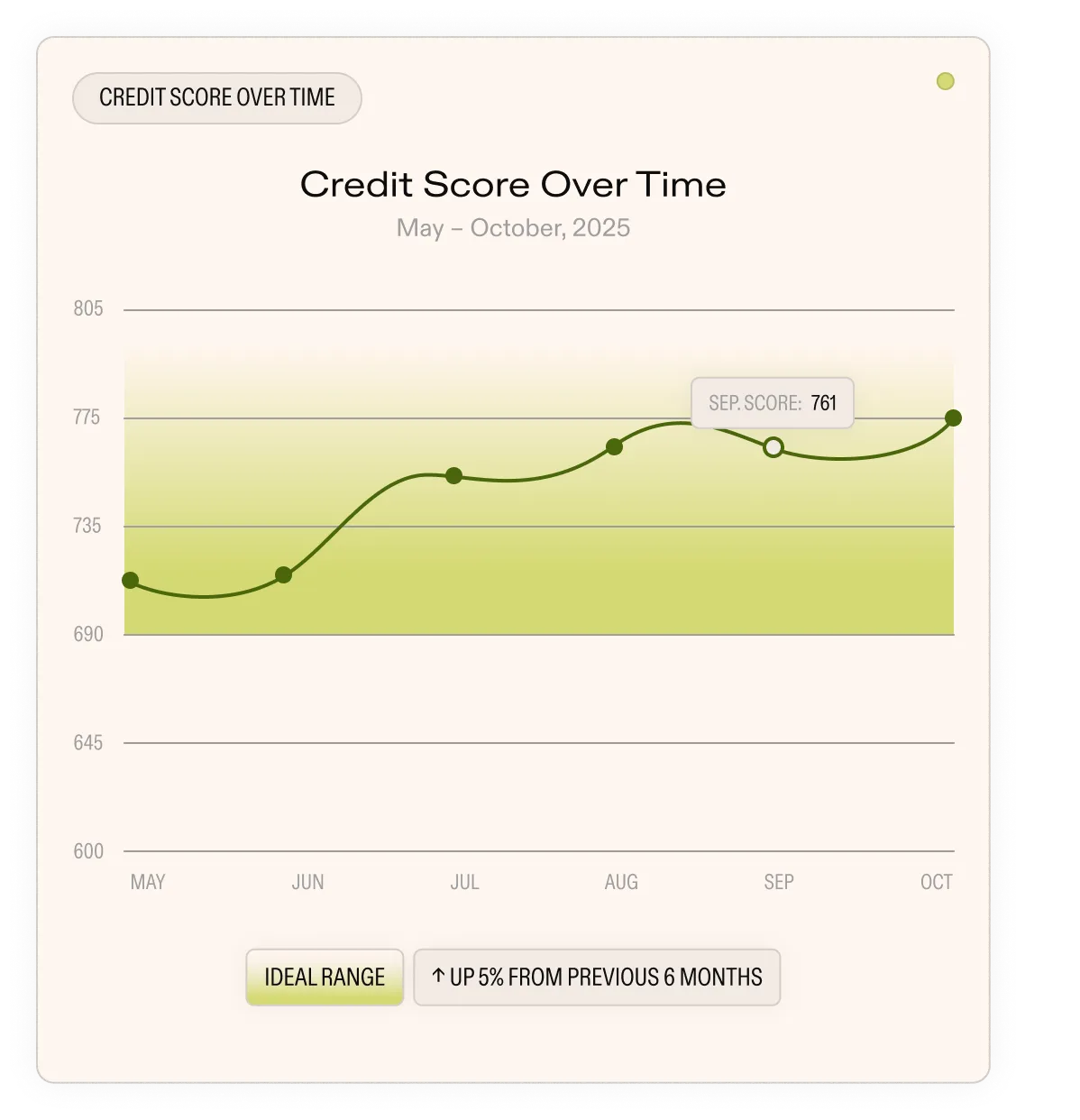
Trend Tracking
Track your growth over time, and pair it with our cash flow insights to see how lenders view your entire business.
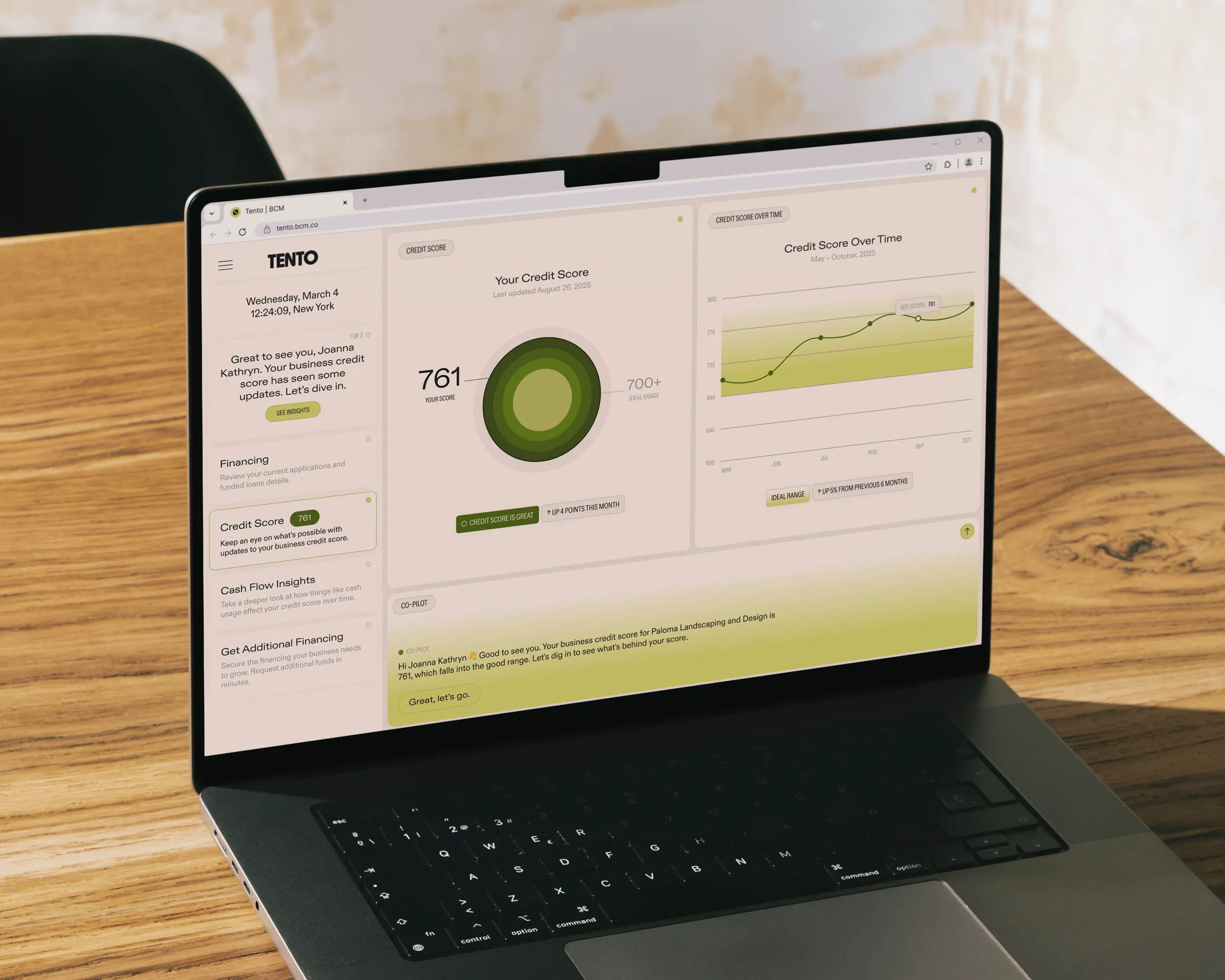

No hard credit check.
Get the score that lenders use.
Create your free account
Just your name, email, and business EIN. No credit card, always start for free.
We partner with Equifax
Soft inquiry only. We pull your credit score from the bureau most trusted by small business lenders.
Your score is live
Monitor your business credit score, dig into insights driving it, go further with cash flow insights.
Start free. Know it's right for you.
The first two months are completely free — not a teaser, and no credit card to start. On month three you decide whether to keep full access at $14.99/month; you're only charged if you choose to subscribe, and you can cancel anytime from your Tento dashboard. Soft inquiry only, never hurts your credit score.
Start free. First two months at $0.
After that $14.99/month
- → Business credit score from Equifax
- → Email alerts on changes
- → Ask our AI credit companion anything about your score
- → See the full picture with cash flow insights
Customer testimonials
“Tento gave us access to two things: our credit data that we didn't know existed and a path to boost our score to qualify for better financing.”
— Rachel K.
Reviewed on Google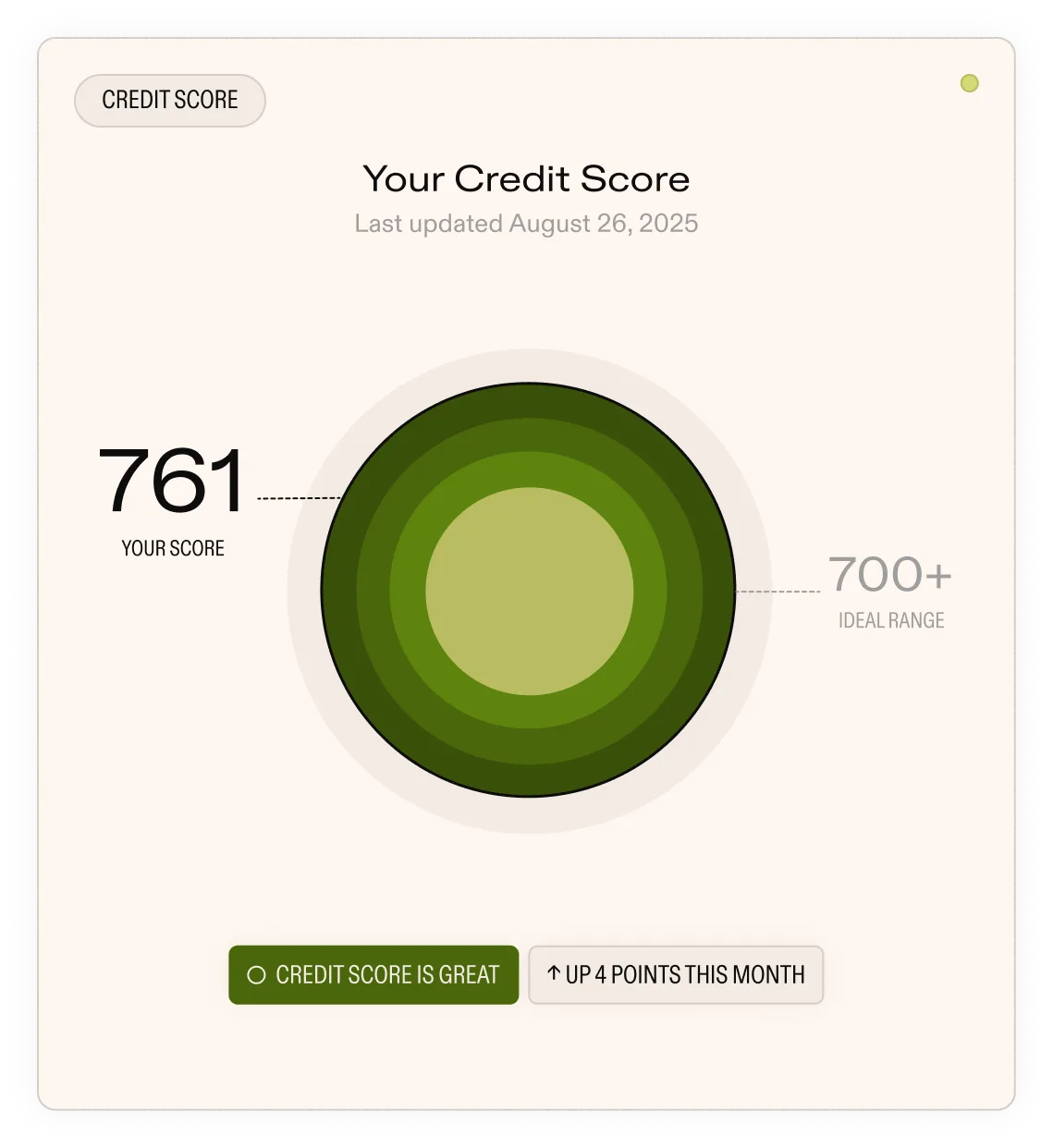

See what lenders see, and move confidently towards your business goals
Start for free. No hard inquiry. No credit card.


A business credit score is a number — similar to a personal credit score — that reflects the creditworthiness of your business. It's based on your business's payment history, debt levels, and other financial behaviors. Lenders, suppliers, and partners use it to evaluate your business.
Your business credit score is really a tool that can help you grow if you use it properly. Here are three ways you can use it to benefit your business:
Securing Financing: Most lenders check business credit before approving loans. A strong credit score can mean higher approval odds and better loan terms, including lower interest rates.
Negotiating Payment Terms: Vendors often assess creditworthiness to determine whether you qualify for favorable terms, like Net 30, 60, or 90. Poor credit could mean upfront payments or stricter terms.
Building Credibility: A solid credit score signals financial stability, which can open doors to stronger partnerships and long-term collaborations.
Yes — and we'll be specific about what "free" means, because a lot of this category isn't.
Your business credit score from Tento is free for your first two months. No credit card to start. It's a soft inquiry, so checking never affects your score. On month three you decide whether to keep going, at $14.99/month — you're only charged if you choose to subscribe, and you can cancel anytime from your Tento dashboard.
We think you should be able to see the actual number and experience our product before you pay anything.
Nothing happens automatically. Your first two months are free with no credit card on file, so there is nothing to cancel during the free period — if you do nothing, you simply aren't charged.
From month three, keeping full access costs $14.99/month, and only if you choose to subscribe. If you do subscribe, you can cancel anytime from your Tento dashboard under Manage subscription — the same place you signed up. No calls, no forms.
No. Tento uses a soft inquiry to pull your business credit score. Soft inquiries do not affect your score in any way. You can check as often as you'd like.
Business credit and personal credit are distinct types of credit profiles that serve different purposes and are evaluated using separate criteria. In short, business credit tracks the creditworthiness of a business entity, reflecting its financial health, debts, and financial obligations whereas personal credit assesses those same factors about an individual. To learn more about the differences between personal and business credit, check out this article: The Difference Between Personal and Business Credit
Your business credit score through Tento is updated monthly through our partnership with Equifax. You'll receive email alerts when your score changes so you always stay informed.
And if it didn't move this month? That's normal too. Your score only changes when someone reports something new — and plenty of vendors don't report at all. A flat score usually means a quiet file, not a stale one.
If you're looking for more frequent updates, let us know at hello@tento.com
Anchor to 750 or above on the Equifax business credit risk score. That's the range where we consistently see lenders approve without extra conditions.
But "good" depends on which score someone is looking at, and they don't share a scale:
• Equifax business credit risk score — 101 to 992. 750+ is a strong position.
• D&B PAYDEX — 1 to 100. An 80 means you pay on terms; above 80 means you pay early.
• Experian Intelliscore Plus — 1 to 100. 76+ is generally read as low risk.
A number below your target isn't a verdict. It's a starting point — and what matters more to a lender than the reading itself is the direction it's moving.
Like personal credit, business credit takes time to build — so don't expect overnight changes. But a few things move the needle faster than anything else.
• Pay consistently, on time or early. A clean payment history is the first thing a lender looks at when reviewing your profile. Steady, predictable payments do more for you than any single strong month.
• Open accounts that actually report. Plenty of vendors and suppliers never report to the bureaus, which means payments you're already making might be invisible on your file. Ask before you assume an account is helping your score.
• Keep the file active and growing. A thin file resting on one tradeline is fragile. A handful of active, well-paid accounts builds a score that holds up when a lender takes a closer look. Use debt as a strategic tool to help grow your credit.
Unlike personal credit, where Equifax, Experian, and TransUnion dominate, business credit is reported by a separate set of bureaus — and most small business owners don't realize they're being tracked by more than one.
Equifax Business pulls from a mix of lenders, suppliers, and public records to generate a business credit risk score. It's one of the most widely used by commercial lenders when evaluating loan applications, which makes it a meaningful number to monitor.
Experian Business (also called Intelliscore Plus) scores businesses on a 1–100 scale and is commonly used by vendors and suppliers deciding whether to extend trade credit.
Dun & Bradstreet issues a PAYDEX score, also on a 1–100 scale, based primarily on payment history with vendors who report to D&B. One catch: you have to actively register for a D-U-N-S number to get started, and not all lenders weight this score heavily.
FICO SBSS (Small Business Scoring Service) is worth knowing about even though it's not a bureau — it's a composite score used by the SBA and many banks that blends your business and personal credit history together.
The important thing to understand is that these bureaus don't automatically share data with each other, so your scores can vary significantly across them. Tento monitors your Equifax business credit score — the one most relevant to lenders evaluating you for equipment financing and business working capital.
It can be tough to secure a small business loan with a low business credit score, but it always depends on the lender's appetite for risk and the impact of other signals that they may consider, like your business' cash flow health.
Here's a quick rundown of what's out there and how Tento is built to meet the needs of small business owners in the most cost effective way.
Nav offers multiple business credit scores – D&B, Experian, and Equifax – alongside your personal credit score for a monthly fee of $39.99. If tracking multiple scores is your thing, Nav is the answer.
Dun & Bradstreet gives you the PAYDEX score, but you have to register for a D-U-N-S number first, and their free tier tells you your score changed without telling you what it is. To get your score every month the subscription cost is $49.99.
Experian Business offers a one time credit report for $59.99 that provides their Intelliscore Plus score.
Where Tento is different: you see the actual Equifax business credit score free for two months, no credit card and no hard credit check. An AI companion explains what's driving your score in plain language instead of handing you a number and a chart. And you can connect your bank through Plaid to see cash flow next to credit — the fuller picture a lender is actually looking at. After the free period, it's $14.99/month.
We believe in sharing the score that lenders actually use. It's not about gaming a system, it's about creating healthy financial habits to build up the score that lenders actually underwrite on. We're built for the business owner who wants to not only know their score, but know what to do about it.
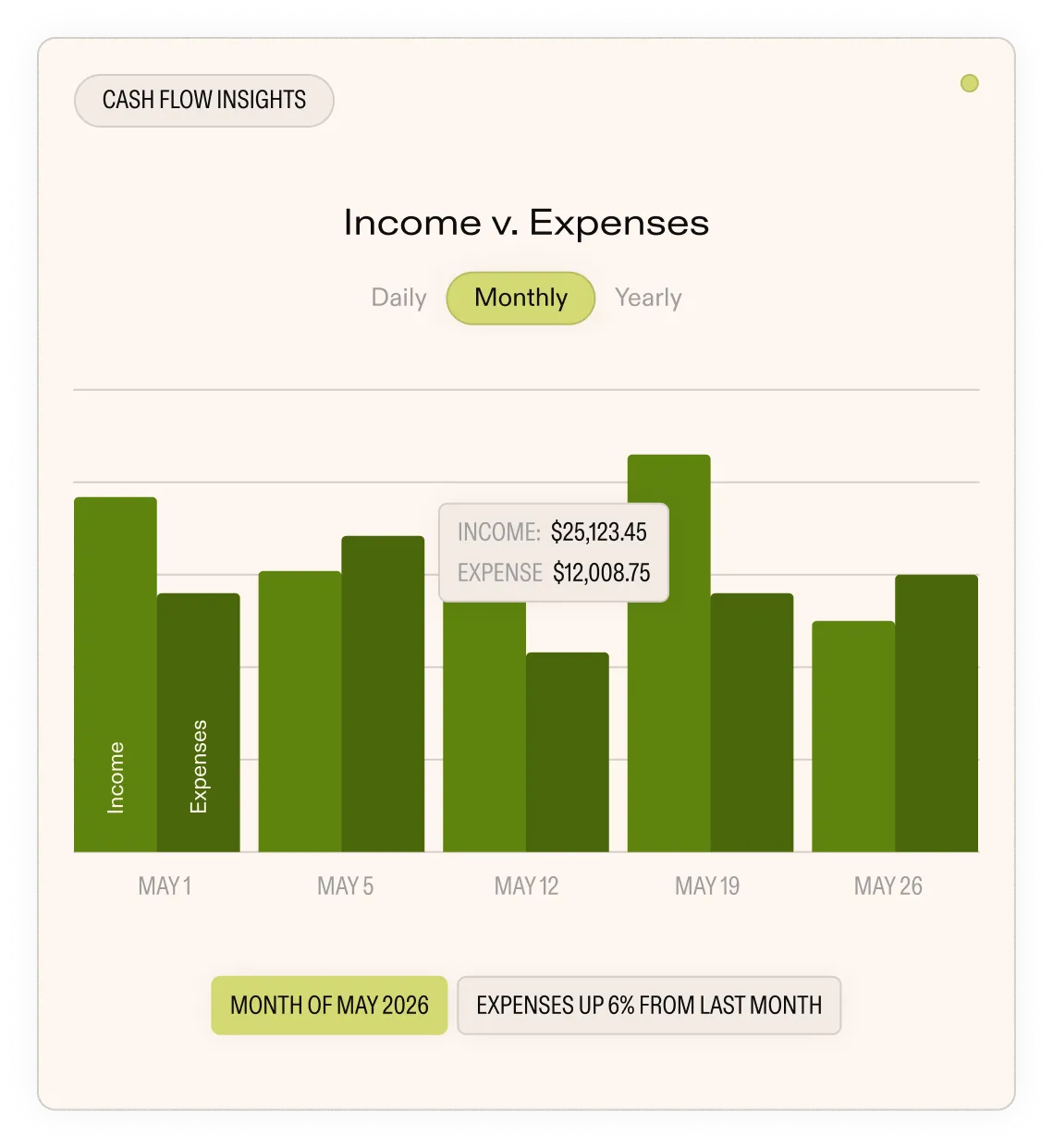
If you connect your business bank account through Plaid in your Tento dashboard you will get access to a set of cash flow charts, designed to give you a quick glance of your cash flow trends. Seeing these alongside your business credit insights is helpful to see the full picture of your business – historical and current.
A personal guarantee means you're personally on the hook if the business can't pay. Lenders ask for one when they can't get comfortable with the business on its own — and the most common reason is that your business credit file is thin, new, or unknown to them.
It isn't a judgment on you. It's a gap in information. If a lender can't see an established payment history for the business as a separate entity, the safest move available to them is to attach the debt to someone whose history they can see. That's you.
Which is why owners with excellent personal credit still get asked for one. Your 800 personal score tells a lender everything about you and nothing about your business.
There could be a variety of reasons driving the decline, but often we see this happen when business credit is thin or non-existent.
Your business has a credit profile separate from your personal one — built on your EIN, the business's payment history, public records, and how your suppliers and lenders report you. A lender evaluating your business pulls that file and it tells them how you handle debt.
The most common version of this: an owner with 780+ personal credit, several years in business, and consistent revenue gets denied — or approved only with a personal guarantee — because the business credit file is thin, or has something in it they never knew was there. The fix starts with actually knowing your score and building your business credit strategically.
The goal is to make the business creditworthy on its own, so a lender doesn't need you as the backstop. In practice:
• Separate the business, legally and financially. A registered entity, an EIN, and a business bank account. Without these there's no separate business for a lender to underwrite.
• Build tradelines that actually report. Vendor accounts, a business card, net-30 terms with suppliers who report to the bureaus. Ask first — many don't.
• Pay early and stay consistent. Payment history is the single largest input.
• Give it time, and watch the file. Most owners need 12–24 months of clean, reported history before lenders will drop the PG requirement.
Be realistic: nobody goes from a thin file to PG-free financing in a month. But knowing where your file actually stands today is what turns a vague "someday" into a timeline you can work against.
The current landscape:
• Tento — free for two months, then $14.99/month. Equifax score, soft inquiry, no credit card to start.
• D&B CreditSignal — free, but it only alerts you that your score changed. It won't show you the score. To see your PAYDEX score every month, D&B's paid monitoring runs $49.99/month.
• Experian Business — a one-time credit report with their Intelliscore Plus score runs $59.99.
• Nav — for $39.99/month their Track product allows you to track your business credit score across multiple bureaus.
"Cheapest" and "most useful" aren't the same thing. A free alert that won't show you the number isn't really monitoring. What you want is the actual score every month, what's driving it, and a signal when it moves.
In our 20 years of experience in small business lending, most commercial lenders underwriting a small business loan pull Equifax. That's why Tento is built on it.
It isn't the only one. Experian's Intelliscore is common with vendors extending trade credit. D&B's PAYDEX matters if your suppliers report there. Banks and the SBA often use FICO SBSS, which blends your business and personal credit together.
But if the question is "which number is most likely to decide whether I get approved," Equifax is the one to know. The bureaus don't share data with each other, so your scores can differ meaningfully — and the one you can check free elsewhere often isn't the one being pulled on you.
Some do. Many don't. This is the part almost nobody tells you.
You can pay a supplier perfectly on net-30 terms for two years and have it contribute nothing to your business credit file, because that supplier never reports to a bureau. It's one of the most demoralizing things about building business credit — doing everything right and getting no credit for it.
Before you open an account expecting it to build your file, ask the vendor directly: do you report payment history, and to which bureaus? If they can't answer, assume they don't. Then check your actual report to confirm what's landing.
The needs are the same as any small business, with two wrinkles that hit the trades harder.
First, contractors get asked for a personal guarantee on equipment financing and credit lines more often than most — equipment is a big ticket, and the business credit file is frequently thin. Second, the trades run heavily on supplier and net-30 accounts, so whether those suppliers report to the bureaus makes an outsized difference to your file. Learn more about specific questions contractors are asking here: Business Credit for Contractors.
What to look for: the Equifax business credit score, since it's what most commercial and equipment lenders pull; visibility into which of your accounts are actually reporting; and a view of cash flow alongside credit, because seasonal revenue swings are exactly what an underwriter will ask about.